<?xml version="1.0" encoding="utf-8"?>
<feed xmlns="http://www.w3.org/2005/Atom">
  <title>Etienne.co</title>
  <subtitle>Leading product design at Europe&#39;s leading AI defence company. Thinking out loud about technology, Europe, and how things get built.</subtitle>
  <link href="https://etienne.co/feed.xml" rel="self"/>
  <link href="https://etienne.co"/>
  <updated>2026-06-10T00:00:00Z</updated>
  <id>https://etienne.co/</id>
  <author>
    <name>Etienne Servant</name>
  </author>
  <entry>
    <title>Collective Reality Distortion Field</title>
    <link href="https://etienne.co/writing/collective-reality-distortion-field/"/>
    <updated>2026-06-10T00:00:00Z</updated>
    <id>https://etienne.co/writing/collective-reality-distortion-field/</id>
    <content type="html"><![CDATA[<p>If you asked me why I joined Helsing four years ago, I would have talked about the mission. I’d have told you about the importance of protecting the sovereignty of European democracies.</p>
<p>A couple of years later, I’d have talked about the craft. The fascinating design and engineering complexity of physical-AI systems and high-stakes user interfaces.</p>
<p>Today, I mostly talk about the team, why this group of people makes this place special—and a strange phenomenon we’ve built here: a collective &quot;reality distortion field.&quot;</p>
<p>When you look at the systems we are building—from autonomous fighter jets and AI strike drones to underwater autonomous vehicles and more—by all traditional standards, each should require hundreds of people, layers of committees, and years of &quot;requirements gathering&quot; and &quot;alignment&quot;.</p>
<p>Then you get here, and you watch a handful of people build and ship in a couple of weeks—work you’ve been taught should take months or years.</p>
<p>How does something like that actually happen?</p>
<p>I think there is a simple, mechanical reason for it. It isn't just about &quot;hiring smart people&quot;—most tech companies do that and still drown in inertia. It happens when you combine three specific things: surreal talent density, extreme individual agency, and a culture of raw, high-substance curiosity grounded in first principles.</p>
<p>No matter how niche, complex, or obscure the topic is — you are always exactly one Slack message away from someone who deeply understands it. The distance between a hard question and a frontier-level answer is virtually zero.</p>
<p>I find myself reading my inbox, Slack, and Confluence pages with the same excitement I had reading Hacker News 15 years ago—you are reading people writing deeply about the raw truth of how things work, charting entirely unknown territories, and demystifying things you once thought were far too difficult to understand.</p>
<p>When you put exceptionally capable people in a room under those conditions and let them own things end-to-end, you don't just work faster—you change what the team believes is possible, and collapse traditional timelines.</p>
<p>I remember reading Steve Jobs’ biography many years ago, wondering what his &quot;reality distortion field&quot; must have actually felt like. It sounded like some kind of black magic—one charismatic leader convincing a room that the impossible was simple, just by force of will.</p>
<p>But what I'm experiencing here is different. It’s still a reality distortion field, but it isn’t being imposed from the top down. It is a collective property of the team itself.</p>
<p>This collective distortion field isn't just a nice cultural perk; it’s the entire game. It’s our ultimate unfair advantage.</p>
<p>You stop saying <em>&quot;that will take two quarters, 20-person teams, and deprioritizing X, Y, and Z,&quot;</em> and start saying <em>&quot;let's take this handful of people, have a simulation running by next week, and make it fly within three months.&quot;</em> And because you are surrounded by people who believe they can do it—and who have the raw capability to back it up—you do.</p>
]]></content>
  </entry>
  <entry>
    <title>Memories from Ukraine</title>
    <link href="https://etienne.co/writing/notes-from-ukraine/"/>
    <updated>2025-12-09T00:00:00Z</updated>
    <id>https://etienne.co/writing/notes-from-ukraine/</id>
    <content type="html"><![CDATA[<p><img src="/img/image.jpg" alt="alt text" title="Title"></p>
<p>On the long train from Lviv to Kyiv, I did what I always do on long journeys: opened Strava and  fell down a rabbit hole of cycling routes.</p>
<p>I found the Ukrainian cycling community. Men in their 20s and 30s — same age as me, same kit, same obsessive documentation of climbs and intervals. I followed a dozen of them. Traced their routes on the map. Added some to a list of roads I want to ride when peace returns.</p>
<p>Their ride logs are irregular. Weeks of nothing, then a cluster of activities, then nothing again. Brief rotations away from the front.</p>
<div class="inline-gallery"><figure class="gallery-item"><img src="/img/_(1_of_2).jpg" alt="" loading="lazy"></figure><figure class="gallery-item"><img src="/img/_(2_of_2).jpg" alt="" loading="lazy"></figure></div>
<p>I had arrived through Poland the night before, on a budget airliner — the kind built for stag weekends and cheap sun. Patriot systems visible on the tarmac, military equipment waiting for transfer. The scale of what it takes to keep a country fighting, laid out in hardware. The border crossing itself was mundane. Much faster than CDG. A stamp, and I was in.</p>
<div class="inline-gallery"><figure class="gallery-item"><img src="/img/_(1_of_4).jpg" alt="" loading="lazy"></figure><figure class="gallery-item"><img src="/img/_(2_of_4).jpg" alt="" loading="lazy"></figure><figure class="gallery-item"><img src="/img/_(3_of_4).jpg" alt="" loading="lazy"></figure><figure class="gallery-item"><img src="/img/_(4_of_4).jpg" alt="" loading="lazy"></figure></div>
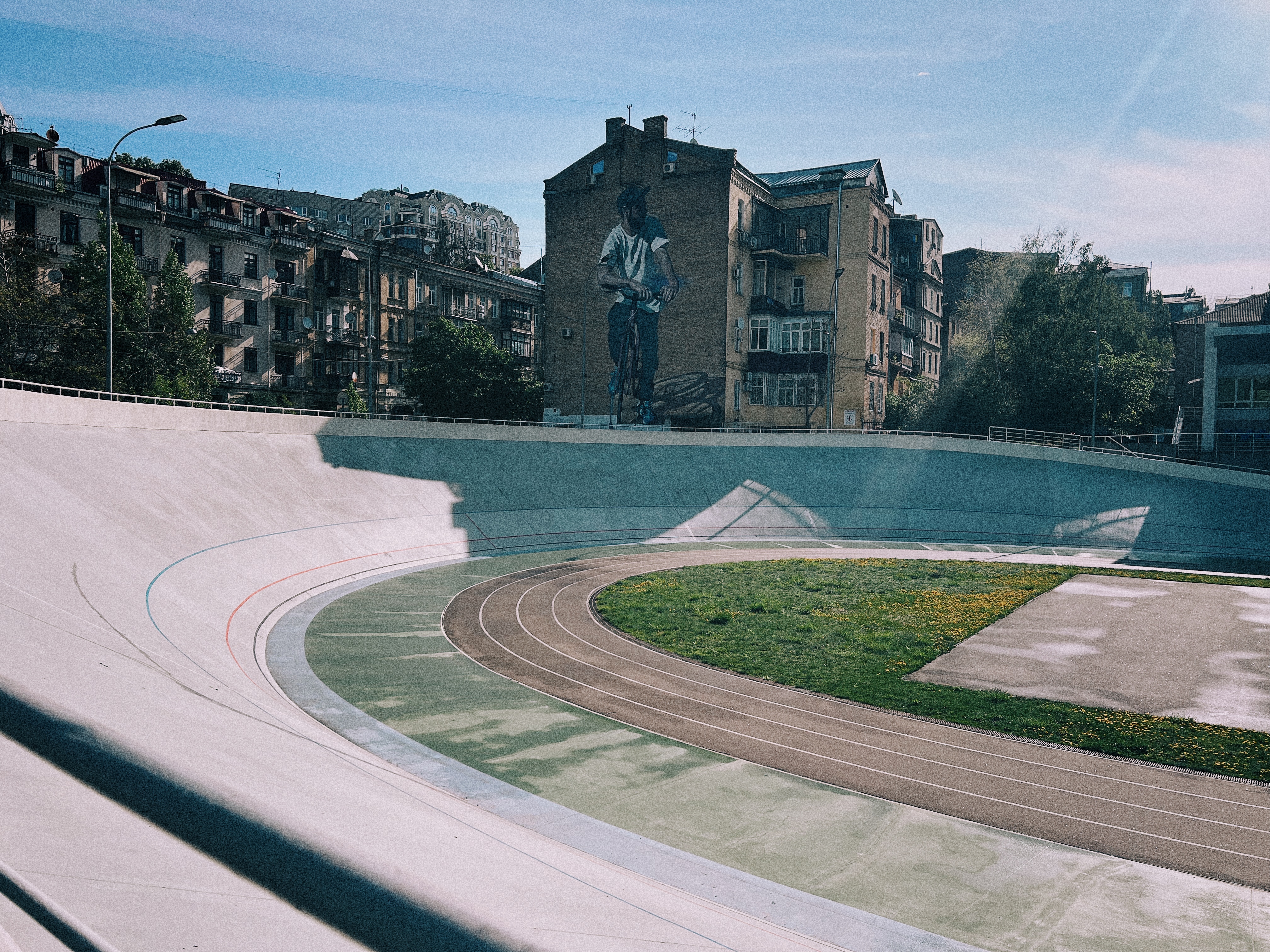
<p>Ukraine looks like Europe. Green fields, commercial strips, shops you'd recognise. That familiarity is what makes it hard to hold. Kyiv has great restaurants, great coffee, people going about their lives. During the day, the war is mostly invisible. At night it isn't. Air raid alerts become routine quickly. You learn the shelter locations, pack a bag before bed — clothes, battery, water — and sleep knowing you might be woken and moved underground. You carry on.</p>
<p><img src="/img/image-2.jpg" alt="alt text" title="Title"></p>
<div class="inline-gallery"><figure class="gallery-item"><img src="/img/_(1_of_3)-2.jpg" alt="" loading="lazy"></figure><figure class="gallery-item"><img src="/img/_(2_of_3)-2.jpg" alt="" loading="lazy"></figure></div>
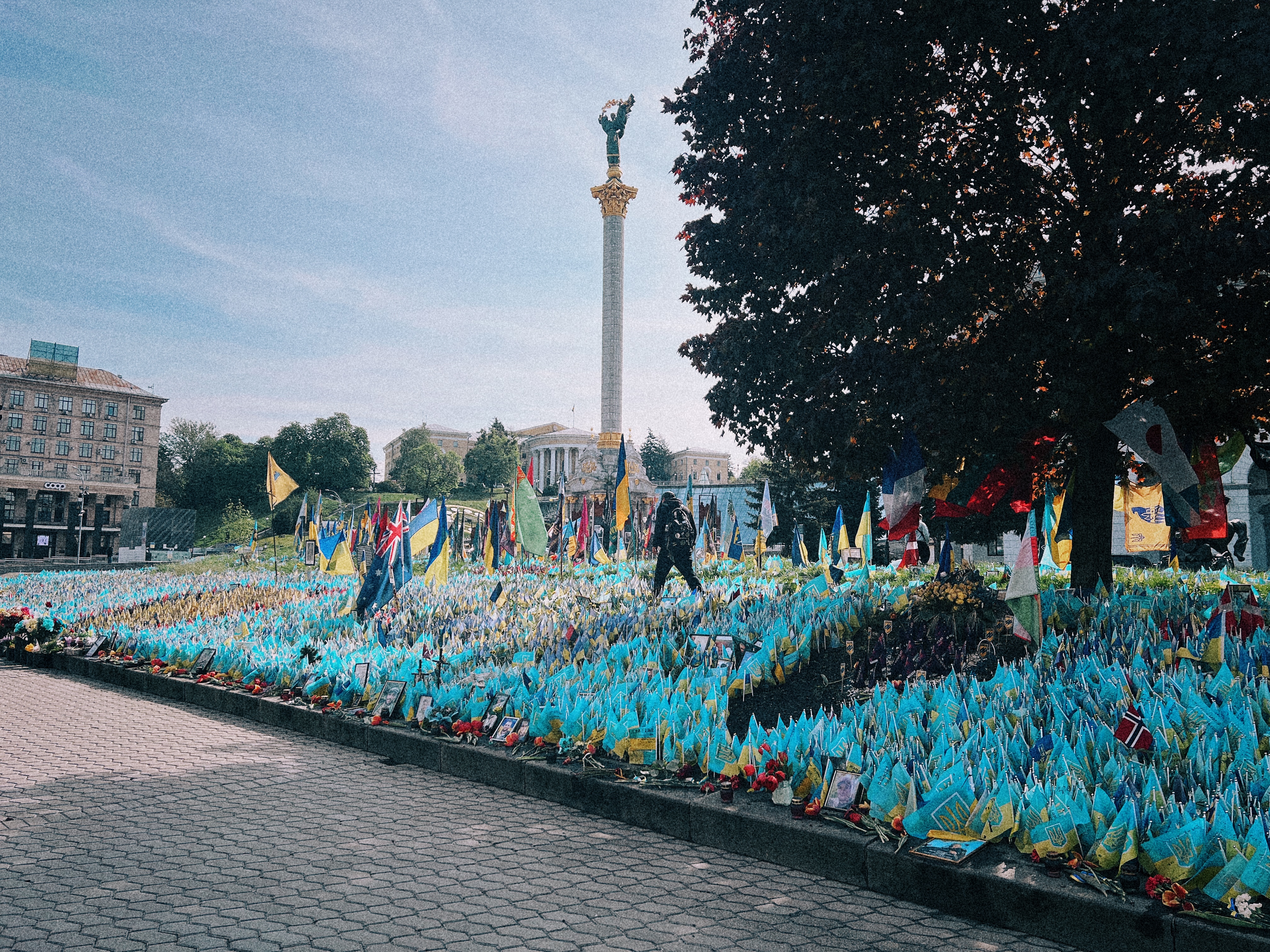
<p>At Mykhailivska Square, captured Russian vehicles sit on public display. Trophies. Evidence. At Maïdan Nezalezhnosti, I stopped for a long time. I had followed the 2014 uprising online, watching it unfold tweet by tweet from a safe distance. Standing on that ground was something I hadn't anticipated emotionally. Thousands of small flags in the grass, each one a soldier. They move in the wind. The uprising I watched online wasn't a conclusion — it was a chapter.</p>
<p>The scars you don't see immediately are demographic. Walking the streets, something felt off before I could name it. Women, children, young adults everywhere — and fewer men in their 30s, 40s, 50s. A society-shaped hole where a generation of men would normally be. At the train station, I saw families sending soldiers back to the front. The air thick with a specific kind of love.</p>
<p><img src="/img/_(1_of_2)-2.jpg" alt=""></p>
<p>One image I won't lose: a young girl at the bottom of an escalator, watching her father ascend. She was old enough to understand what goodbye might mean here. She was physically sick from the weight of it, her mother holding a bag for her.</p>
<p>Recently, one of the cyclists I followed on Strava was killed in action. A fellow rider who won't ride again. A fellow father who won't come home to his daughter.</p>
<p>I carried back home some memories. The flags in the grass. The goodbyes on this escalator. The irregular ride logs that will eventually stop updating.</p>
]]></content>
  </entry>
</feed>